
CIMFS-32 Cell Impedance and MEA(Microelectrode Array) System


- The CELLAMES CIMFS-32 (Cell Impedance and Microelectrode array System) is designed for real-time and non-destructive monitoring of both cellular impedance and bioelectrical activity under various culture conditions.
- CIMFS-32 integrates the complete features of the CIMS-32 and CFPS-32, bringing impedance and electrophysiological monitoring together in one system.
- It enables simultaneous assessment of morphological and electrophysiological changes in cells, providing comprehensive insights into cell behavior, function, and drug response.
- The CIMFS-32 system integrates impedance-based cell analysis and local field potential (LFP) monitoring via MEA(Microelectrode Array) technology, making it a powerful platform for applications in cytotoxicity testing, cardiac safety evaluation, and immuno-oncology research.
- Real-time and non-destructive cell monitoring
- Visualization of cell adhesion, proliferation, and death
- CC50 and KT50 analysis from viability and cytolysis data
- Multi-frequency impedance measurement(10 ~ 50 kHz)
- Analysis of impedance magnitude, resistance, capacitance, and phase
- Export of raw and processed data in CSV and Excel (XLSX) formats
- Cell Proliferation, Cytotoxicity, Immuno-Oncology
- Customizable data view settings based on user preferences
- Real-time and Non-destructive Monitoring of cardiomyocyte and neuron activity
- MEA(Microelectrode Array)-based recording of bioelectrical signals
- Assessment of cardiomyocyte contraction strength via impedance
- Detection of drug-induced signal changes
- 12.5K Sample/s Sampling
- Measurement channel and time interval selection function
- Measurement of Beat Period, Spike Amplitude, and Field Potential Duration (FPD)
- Quantitative analysis of functional changes in excitable cells
- Detection of drug-induced signal changes
- User-friendly GUI and data analytics software
- Contractility
- Electrical Stimulation
- 32 Channel Measurement Station Compatible with Both CIMS-Plates/CFPS-Plates
- Laptop PC
- SW for Control, Data Acquisition, and Display
- Consumable CIMS-Plates/CFPS-Plates
- User-Friendly Access using USB Type-C Cable
- Removable Chamber for Staining and Microscopic
- Examination Without Cell Transfer
CIMFS-48 Cell Impedance and MEA(Microelectrode Array) System
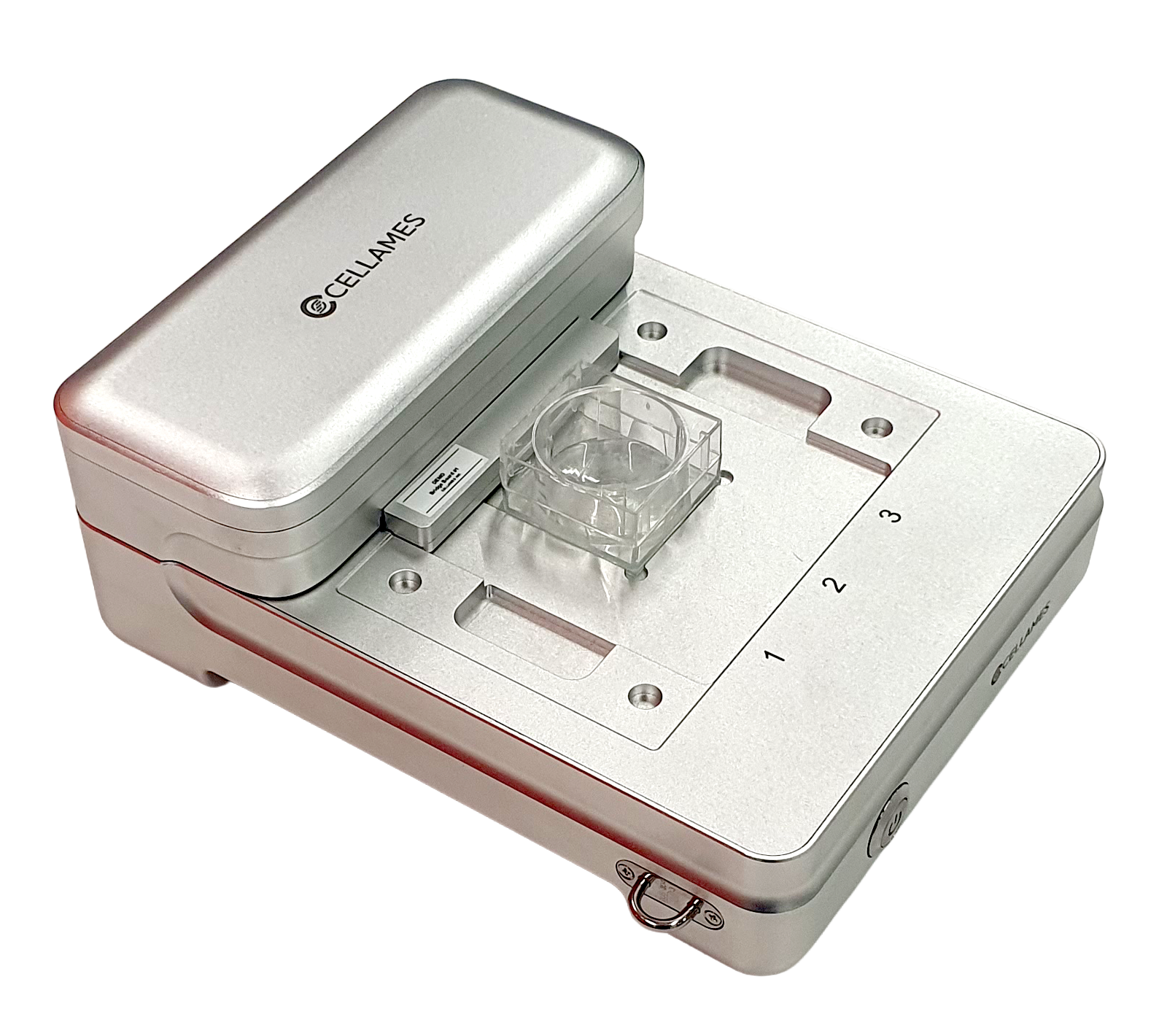
- The CELLAMES CIMFS-48 (Cell Impedance and Microelectrode array System) is designed for real-time and non-destructive monitoring of both cellular impedance and bioelectrical activity under various culture conditions.
- CIMFS-48 integrates the complete features of the CIMFS-32, bringing impedance and electrophysiological monitoring together in one system.
- It enables simultaneous assessment of morphological and electrophysiological changes in cells, providing comprehensive insights into cell behavior, function, and drug response.
- The CIMFS-48 system integrates impedance-based cell analysis and local field potential (LFP) monitoring via MEA(Microelectrode Array) technology, making it a powerful platform for applications in cytotoxicity testing, cardiac safety evaluation, and immuno-oncology research.
- Real-time and non-destructive cell monitoring
- Visualization of cell adhesion, proliferation, and death
- CC50 and KT50 analysis from viability and cytolysis data
- Multi-frequency impedance measurement(10 ~ 50 kHz)
- Analysis of impedance magnitude, resistance, capacitance, and phase
- Export of raw and processed data in CSV and Excel (XLSX) formats
- Cell Proliferation, Cytotoxicity, Immuno-Oncology
- Customizable data view settings based on user preferences
- Real-time and Non-destructive Monitoring of cardiomyocyte and neuron activity
- MEA(Microelectrode Array)-based recording of bioelectrical signals
- Assessment of cardiomyocyte contraction strength via impedance
- Detection of drug-induced signal changes
- 18.4K Sample/s sampling rate at 48 channels
- Measurement channel and time interval selection function
- Measurement of Beat Period, Spike Amplitude, and Field Potential Duration (FPD)
- Quantitative analysis of functional changes in excitable cells
- Detection of drug-induced signal changes
- User-friendly GUI and data analytics software
- Contractility
- Electrical Stimulation
- 48 Channel Measurement Station Compatible with Both CIMS-Plates/CFPS-Plates
- Laptop PC
- SW for Control, Data Acquisition, and Display
- Consumable CIMS-Plates/CFPS-Plates
- User-Friendly Access using USB Type-C Cable
- Removable Chamber for Staining and Microscopic
- Examination Without Cell Transfer
CIMFS-96 Cell Impedance and MEA(Microelectrode Array) System

- The CELLAMES CIMFS-96 (Cell Impedance and Microelectrode array System) is designed for real-time and non-destructive monitoring of both cellular impedance and bioelectrical activity under various culture conditions.
- CIMFS-96 integrates the complete features of the CIMFS-32, bringing impedance and electrophysiological monitoring together in one system.
- It enables simultaneous assessment of morphological and electrophysiological changes in cells, providing comprehensive insights into cell behavior, function, and drug response.
- The CIMFS-96 system integrates impedance-based cell analysis and local field potential (LFP) monitoring via MEA(Microelectrode Array) technology, making it a powerful platform for applications in cytotoxicity testing, cardiac safety evaluation, and immuno-oncology research.
- Real-time and non-destructive cell monitoring
- Visualization of cell adhesion, proliferation, and death
- CC50 and KT50 analysis from viability and cytolysis data
- Multi-frequency impedance measurement(10 ~ 50 kHz)
- Analysis of impedance magnitude, resistance, capacitance, and phase
- Export of raw and processed data in CSV and Excel (XLSX) formats
- Cell Proliferation, Cytotoxicity, Immuno-Oncology
- Customizable data view settings based on user preferences
- Real-time and Non-destructive Monitoring of cardiomyocyte and neuron activity
- MEA(Microelectrode Array)-based recording of bioelectrical signals
- Assessment of cardiomyocyte contraction strength via impedance
- Detection of drug-induced signal changes
- 18.4K Sample/s sampling rate at 48 channels; 9.2K Sample/s at 96 channels
- Measurement channel and time interval selection function
- Measurement of Beat Period, Spike Amplitude, and Field Potential Duration (FPD)
- Quantitative analysis of functional changes in excitable cells
- Detection of drug-induced signal changes
- User-friendly GUI and data analytics software
- Contractility
- Electrical Stimulation
- 96 Channel Measurement Station Compatible with Both CIMS-Plates/CFPS-Plates
- Laptop PC
- SW for Control, Data Acquisition, and Display
- Consumable CIMS-Plates/CFPS-Plates
- User-Friendly Access using USB Type-C Cable
- Removable Chamber for Staining and Microscopic
- Examination Without Cell Transfer
Cellames Control Hub
Overview Cellames Control Hub is a central management tool for installing, updating, and licensing Cellames software and system firmware.- One-stop access to all Cellames software from a single application
- One-click installation, update, launch, and removal
- Automatic notification of new software versions
- Firmware download and hardware management for connected systems
- License verification linked to the user account
- Direct request channel to the administrator
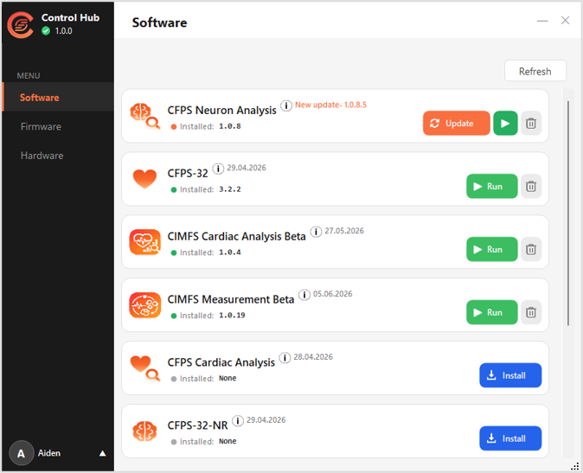
- Install, update, run, and uninstall Cellames software such as CIMFS Measure and Analysis SW
- Current installed version and latest available version shown at a glance
- New update alerts so users always work with the latest version
- Download the latest firmware for Cellames systems
- Keep system performance and stability up to date
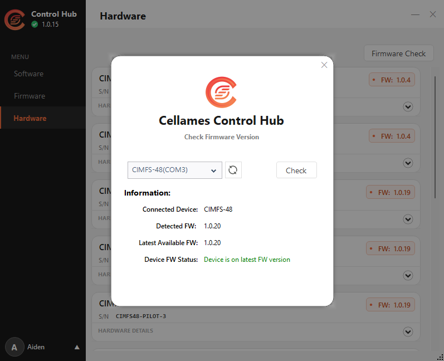
- View and manage registered Cellames systems
- Check system information linked to the user account
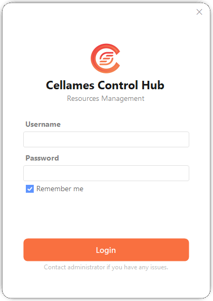
- Secure login with an assigned ID and password
- Automatic license verification before software launch
- Prevents unauthorized copying and distribution of installation files
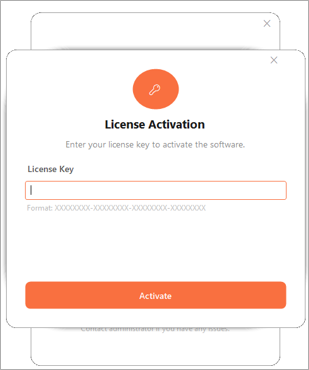
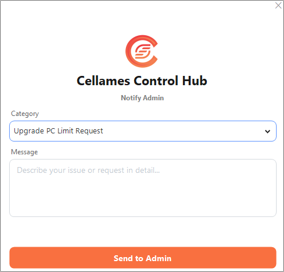
- Send requests such as license extension, additional PC registration, or technical support directly to the administrator
CIMFS Measure Software
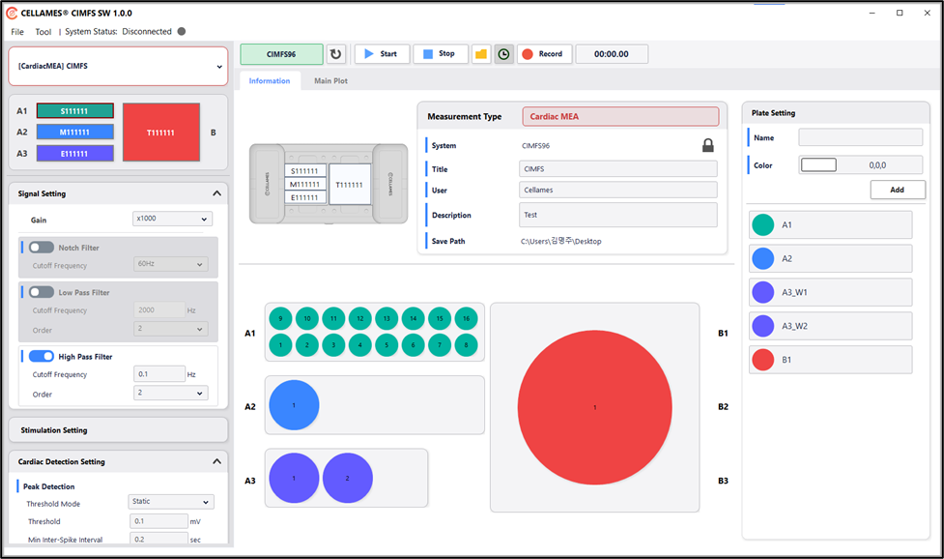
Overview CIMFS Measure SW controls the CIMFS system and acquires impedance and MEA(Microelectrode Array) data in real time, from experiment setup to data export.- Four measurement modes in one software: Impedance, Cardiac MEA, Neuron MEA, and Contractility
- Step-by-step experiment setup: mode selection, system connection, plate selection, and Plate ID entry
- Built-in System Check for connection, plate, and device QC before measurement
- Real-time monitoring with mode-specific plots, heatmaps, and detection settings
- Scheduled recording for long-term, unattended experiments
- Replay of saved experiments and CSV/Excel data export
- Easy installation, updates, and license management via Cellames Control Hub
Impedance
Visualizes impedance changes as graphs to observe changes in cell characteristics such as attachment and detachment, division, growth, and death. Indicators such as CC50 and KT50 can be obtained from the Viability and Cytolysis graphs.
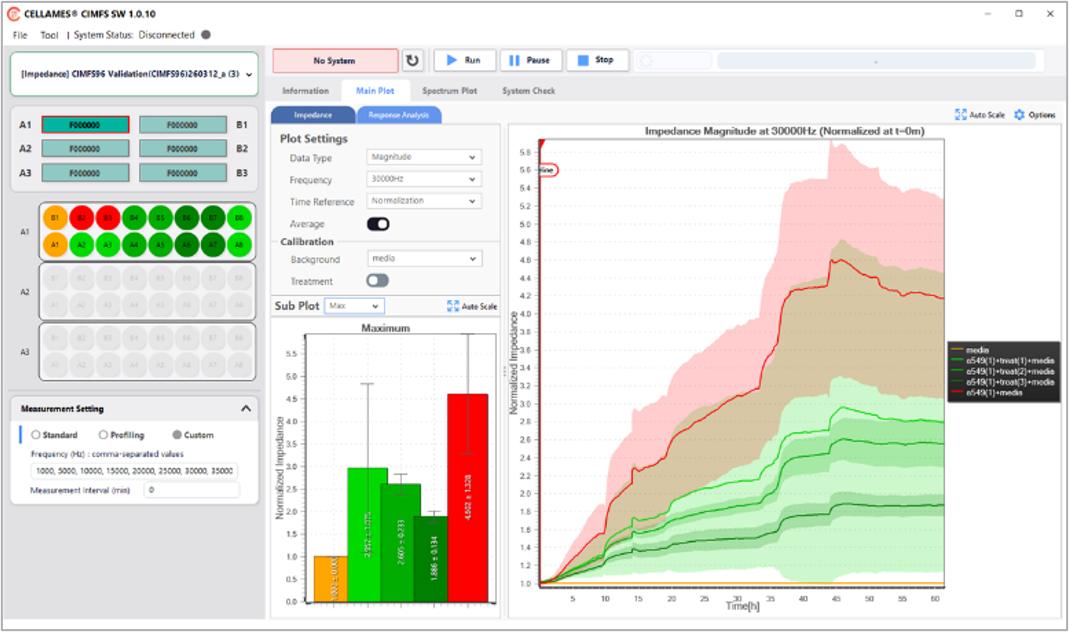
- Preset measurement modes: Standard (1k–30 kHz) and Profiling (1k–50 kHz, 11 frequencies), or Custom frequency and interval (10 Hz–50 kHz)
- Real-time Magnitude, Resistance, Capacitance, Phase and Spectrum graphs
- Normalization, background/treatment calibration, Kalman filter, and SD/SEM display
- Response Analysis: Viability and Cytolysis graphs with CC50/IC50/EC50 sigmoid fitting and KT50
- Report export to Excel and customizable plot images
Cardiac MEA(Microelectrode Array)
Monitors changes in the electrical activity of cardiomyocytes in real time. Parameters such as Beat Period, Spike Amplitude, and Field Potential Duration (FPD) are measured to quantitatively evaluate drug-induced cardiac electrophysiological changes.
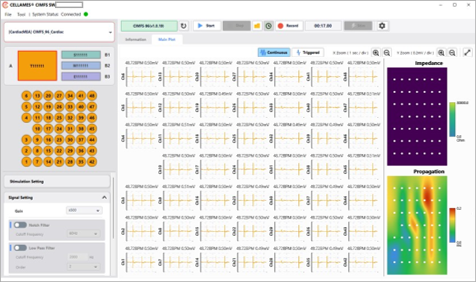
- Signal settings: Gain (x100–x1000), Notch, Low-pass, and High-pass filters
- Peak detection (Static / Adaptive threshold) and T-wave detection (Normal / Low-pass / Regression)
- Real-time BPM and amplitude for each channel, with Continuous and Waveform views
- Impedance map and Propagation map for electrode status and signal conduction
- Baseline QC for cardiotoxicity assays
Neuron MEA(Microelectrode Array)
Monitors changes in the electrical activity of neurons in real time. Spikes are visualized in a Raster Plot, and individual spike waveforms can be overlaid in Triggered mode for visual inspection. Signal changes before and after drug treatment can be compared to evaluate the effect of drugs on neuronal function.
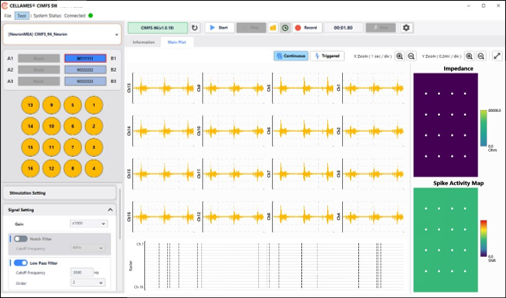
- Spike detection with Static, Adaptive, and Adaptive Cross threshold modes, including bipolar detection
- Triggered view overlays up to 30 recent spikes per channel
- Spike activity heatmap across the plate
Contractility
Evaluates the degree of cardiomyocyte contraction based on impedance. Changes in impedance values before and after drug treatment are analyzed to monitor functional changes in cardiomyocytes.
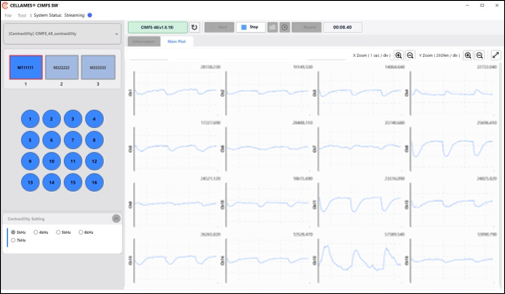
- Impedance-based monitoring of cardiomyocyte contraction
- Selectable measurement frequency (3–7 kHz)
CIMFS Cardiac Analysis Software
Overview CIMFS Cardiac Analysis SW analyzes cardiomyocyte field potential data recorded with CIMFS-32, 48, and 96 systems and generates comparison reports for cardiac safety assessment.- Supports CIMFS-32, CIMFS-48, and CIMFS-96 (32/48/96 channels)
- Plate modes: 8 MEA(Microelectrode Array), 8 Single, 16 MEA, 16 Single, 48 Plate, and Co-Culture
- Baseline vs. comparison analysis with up to 5 data files (1 baseline + 4 comparisons)
- Automatic extraction of stable beats and average beats for each well
- Accurate FPD measurement with multiple T-wave detection methods and manual adjustment
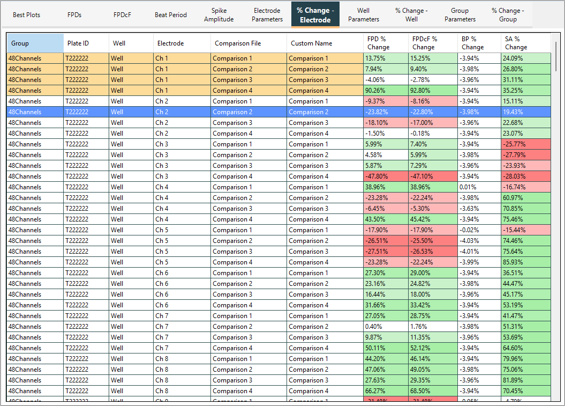
- Percent change of FPD, FPDcF, Beat Period, and Spike Amplitude at the electrode, well, and group level
- One-click PDF report and CSV parameter export
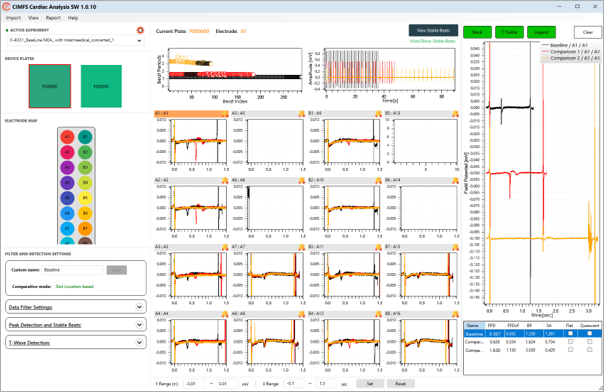
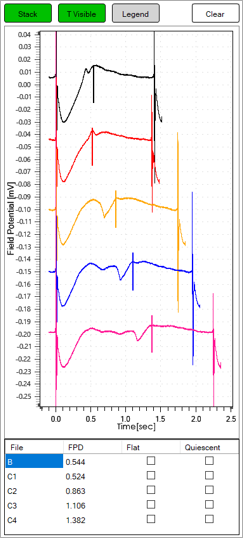
- Average beat waveform for each well based on stable beats
- Best Beat selection for each group as the reference for reporting
- Stacked or overlay view to compare baseline and comparison waveforms
- FPD markers with manual adjustment by double-clicking the waveform
- T-wave re-detection from the average beat or from stable beats
- Automatic Flat and Quiescent detection for abnormal signals
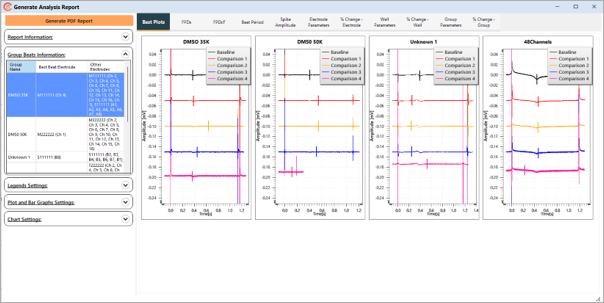
- PDF analysis report with Best Beat plots and parameter tables
- Percent change bar graphs for FPD, FPDcF, Beat Period, and Spike Amplitude
- Comparison at Electrode vs. Electrode, Well vs. Well, and Group vs. Group level
- Standard deviation shown on each bar for consistency within a group
- Parameter export to CSV
CIMFS Neuron Analysis Software
Overview CIMFS Neuron Analysis SW analyzes neural signals recorded with CIMFS-32, 48, and 96 systems. It detects spikes, bursts, and network activity, and calculates parameters at the electrode and well level.- Supports CIMFS-32, CIMFS-48, and CIMFS-96 (32/48/96 channels)
- Plate modes: 8 MEA(Microelectrode Array), 8 Single, 16 MEA, 16 Single, 48 Plate, and Co-Culture
- Detection of spikes, bursts, network bursts, and network spikes, with configurable thresholds
- Quantitative parameters per electrode and per well
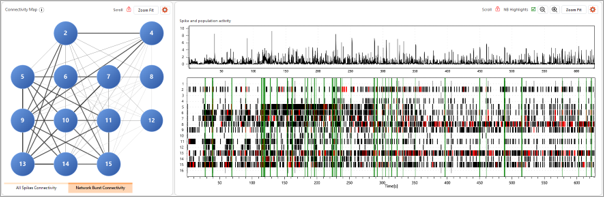
- Raster plot, spike alignment, population firing rate, and connectivity map views
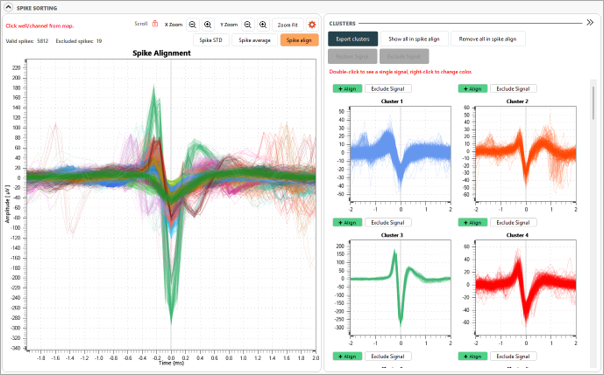
- K-means spike sorting with automatic cluster detection
- CSV export of parameters and spike clusters, with batch export across files
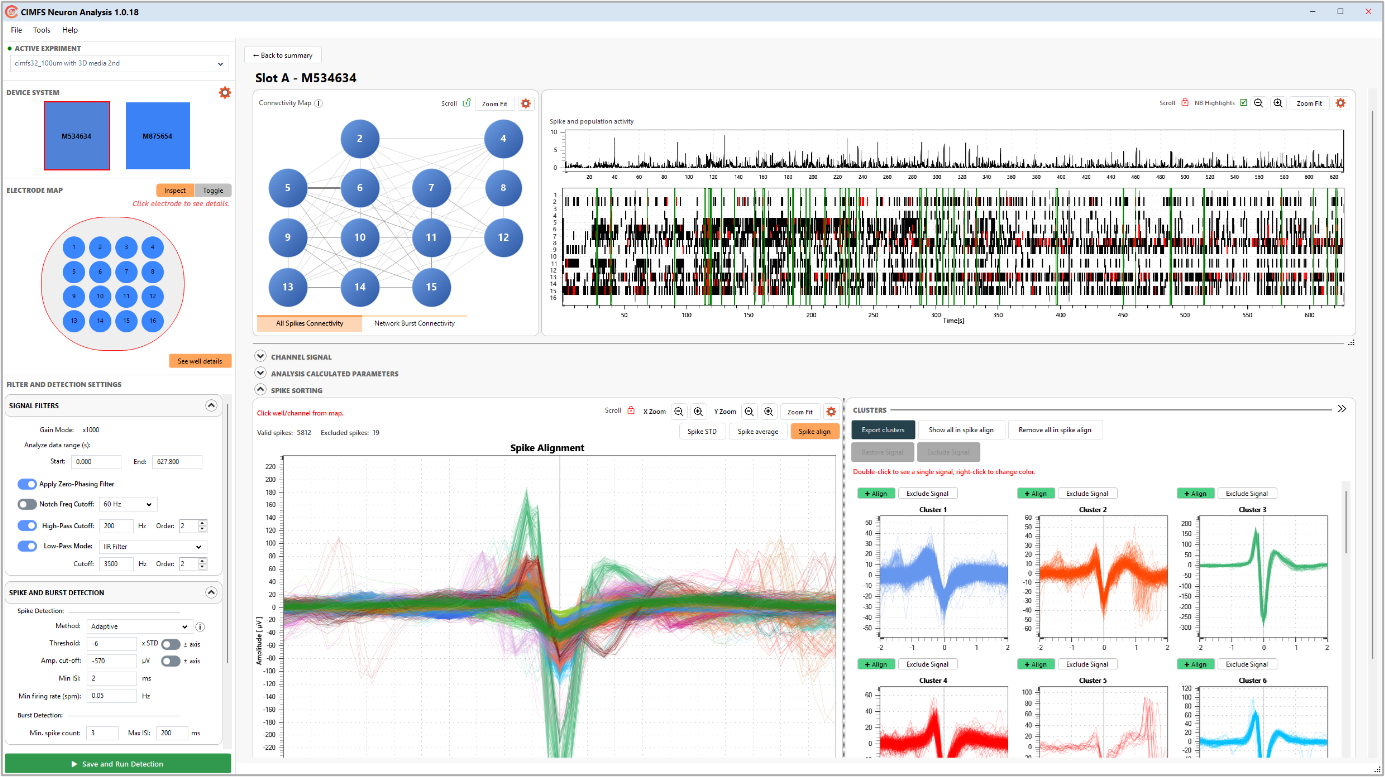
- Spike detection with fixed or adaptive threshold, minimum ISI, amplitude cutoff, and optional bipolar detection
- Burst detection based on maximum ISI and minimum spike count
- Network burst detection based on participating electrode ratio, time window, and IBI, with an envelope-based method using Gaussian smoothing
- Network spike detection based on minimum electrode count and time window
- Functional connectivity between electrodes using the Ochiai or STTC algorithm
- Adjustable time window and threshold
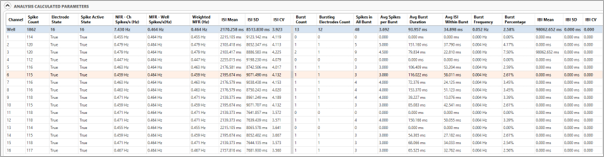
- Spike activity: Spike Count, MFR, Weighted MFR, NFR, ISI (Mean / SD / CV)
- Burst: Burst Count, Burst Frequency, Burst Duration, Spikes per Burst, ISI within Burst, Burst Percentage, IBI (Mean / SD / CV)
- Network Burst: Count, Frequency, Duration, Percentage, INBI (Mean / SD / CV)
- Active Electrode Count
- Results shown at the electrode and well level
- K-means clustering of spike waveforms per electrode or per well
- Automatic cluster number detection and noise separation
- Waveform chart for each cluster, with manual cluster editing
- Electrode- and well-level parameters exported to CSV
- Spike cluster data exported to CSV
- Batch export across multiple files