cellames logo

CELLAMES
Electrode Cell Chip

CIMS-Plate  CFPS-Plate


Gather papers by category
More more button
Cellames paper
More more button

Lung > Cell line > Cellames | White Paper

Simultaneous Impedance and OCR Measurements Reveal Complementary Cellular Responses to Cisplatin in A549 Cells

In this study, the CIMFS-96 system developed by CELLAMES Inc. was used in combination with the Resipher system from Lucid Scientific, Inc. to measure changes in impedance and oxygen consumption rate (OCR) following cisplatin treatment in A549 cells. The relationship between OCR and impedance measurements was then evaluated.
Following treatment with cisplatin at different concentrations (0, 1, 10, and 100 μM), OCR and impedance showed similar cisplatin-induced response trends. However, because OCR primarily reflects mitochondrial oxidative metabolism whereas impedance reflects cell adhesion and morphology, the two measurements should be interpreted as complementary readouts rather than directly proportional parameters.
In addition, overall impedance profiles were comparable between conditions with and without Resipher-based OCR measurements, suggesting that the influence of Resipher measurements on impedance analysis was limited. Impedance measurements also reflected morphology-related changes observed in brightfield images, including changes in cell spreading and cell-electrode coverage, indicating that impedance analysis can provide additional information not directly captured by OCR data. OCR response profiles were similar between ITO electrode-based cell chips and SUS316L electrode-based PCB cell chips, suggesting that the differences in the electrode/substrate configurations had limited influence on OCR measurements under the tested conditions.
Taken together, these findings suggest that the combined use of OCR and impedance measurements may provide a complementary approach for evaluating drug-induced cellular responses.

Cellames Cell Analysis Team
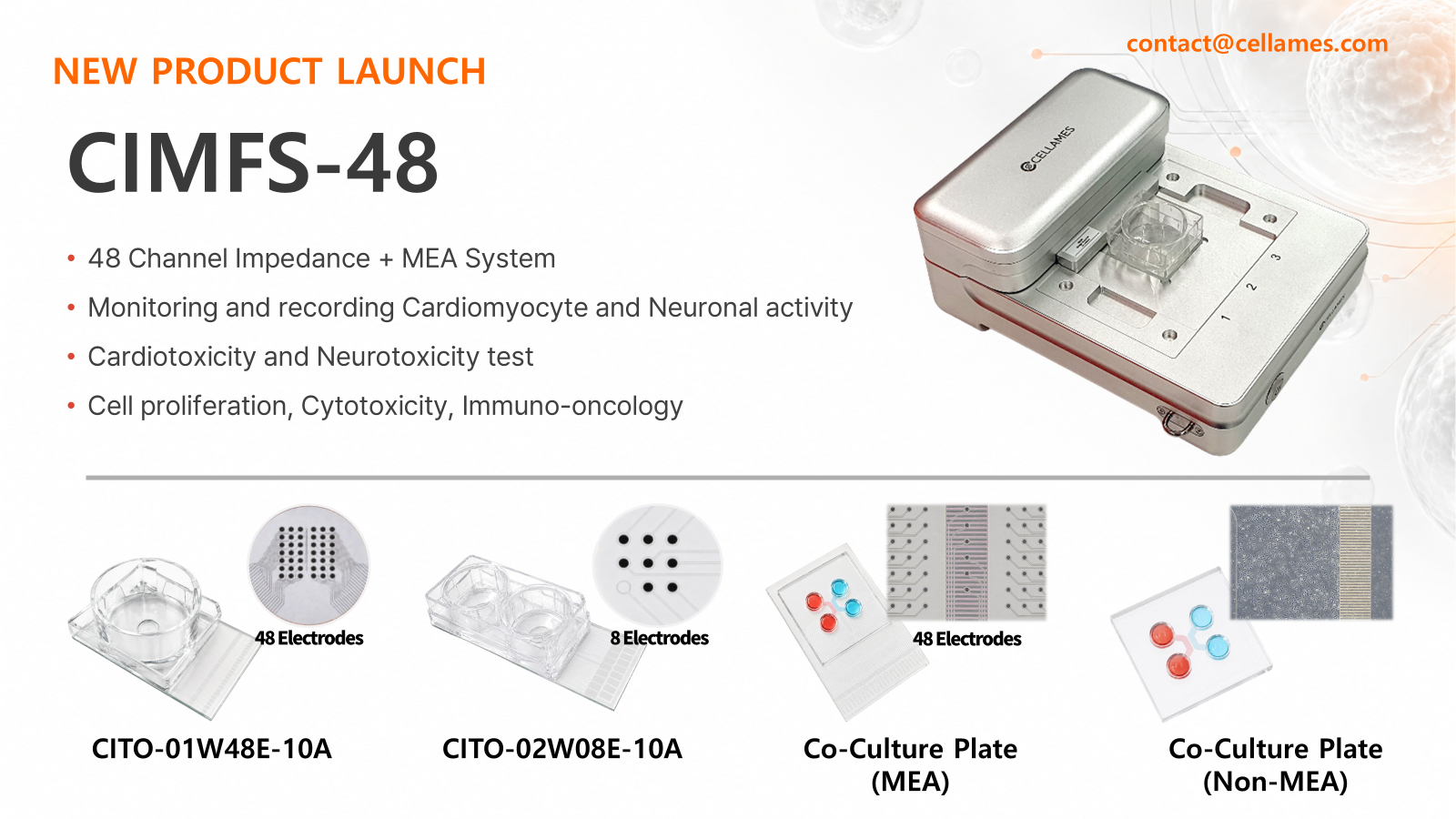
Heart > IPSC > Cellames | Paper

Integrated Electrophysiological and Optical Analysis of Human iPSC-Derived Cardiomyocytes Using Transparent ITO Microelectrode Chip

Cardiotoxicity assessment is a crucial step in the drug development process. With growing interest in alternatives to animal testing, preclinical cardiotoxicity evaluation has become increasingly important. Human-induced pluripotent stem cell-derived cardiomyocytes (iPSC-CMs) offer a physiologically relevant in vitro model for this purpose. As a result, electrophysiological analysis platforms using iPSC-CMs have gained attention. However, conventional microelectrode array (MEA) chips rely on metal electrodes, which are costly and optically opaque. This lack of transparency limits detailed morphological observation of the cells. In this study, we employed an MEA chip incorporating transparent and conductive indium tin oxide (ITO) electrodes to simultaneously monitor both morphological changes and field potential (FP) of iPSC-CMs. iPSC-CMs cultured on ITO chips exhibited stable electrophysiological signals reflecting coupled depolarization and repolarization, along with self-organization. Short-term exposure to ion channel blockers did not induce noticeable morphological alterations; however, dose-dependent changes in FPs were observed. In contrast, treatment with cardiotoxic drugs resulted in morphological damage and reduced cell viability, accompanied by progressive alterations in key FP parameters over the treatment period. These findings demonstrate the potential of ITO-based MEA as next-generation cardiotoxicity evaluation platforms capable of real-time monitoring of both drug-induced electrophysiological responses and optical cellular changes.


Seul-Gi Lee1, Shinhye Park, C-Yoon Kim, Hyung Min Chung

Heart > Organoid > Cellames | Paper

Non-Invasive electrophysiological monitoring of cardiac organoids using 3D-Net-assisted microelectrodes array platform

The rapid advancement of organoids has increased interest in replacing conventional 2D alternatives to animal testing. In drug development, cardiotoxicity assessment is essential, and electrophysiological signals from cardiomyocytes serve as key biomarkers. Accordingly, planar 2D microelectrode array (MEA) chips are widely used. However, cardiomyocytes-based platform fails to reproduce complex in vivo physiological responses, leading to the combination of human cardiac organoids (hCdOs) with 3D sensors. Most of these approaches remain in the research stage and lack standardization. Therefore, there is still a need for methods that can stably evaluate organoids using commercially available 2D MEA chips. In this study, a silicon-based 3D-Net was introduced to enable stable monitoring of hCdOs electrophysiological signals on MEA chip. hCdOs fabricated using established protocols showed morphological and functional reproducibility suitable for drug testing. The 3D-Net prevented organoid flotation, ensured sufficient medium supply, and enabled measurements beyond acute assessment periods without functional impairment. Drug responsiveness varied significantly depending on the presence of 3D-Net and the volume of drug-containing medium. The 3D-Net platform overcomes the limitations of MEA, providing an effective and non-invasive method for functional evaluation and drug screening of hCdOs. Furthermore, this approach is expected to support preclinical evaluation of drug efficacy and safety.

Shinhye Park, Sang-Jun Cho, C-Yoon Kim, Hyung Min Chung & Seul-Gi Lee
Up-to-date paper
More more button

NEWSLETTER

SUPPORT
